It is the story of a land where, thousands of years ago long before the rise of great civilizations humanity first learned to understand the world around it… and to find its place within it. If we return to around 8000 BCE, deep within the Zagros Mountains, we witness the earliest signs of human thought: paintings upon the cave walls of Lorestan in Dusheh, Homian, and Kuhdasht. These images are not merely scenes of hunting; they are humanity’s first attempts to give meaning to life and nature itself. Gradually, this art moved beyond cave walls…
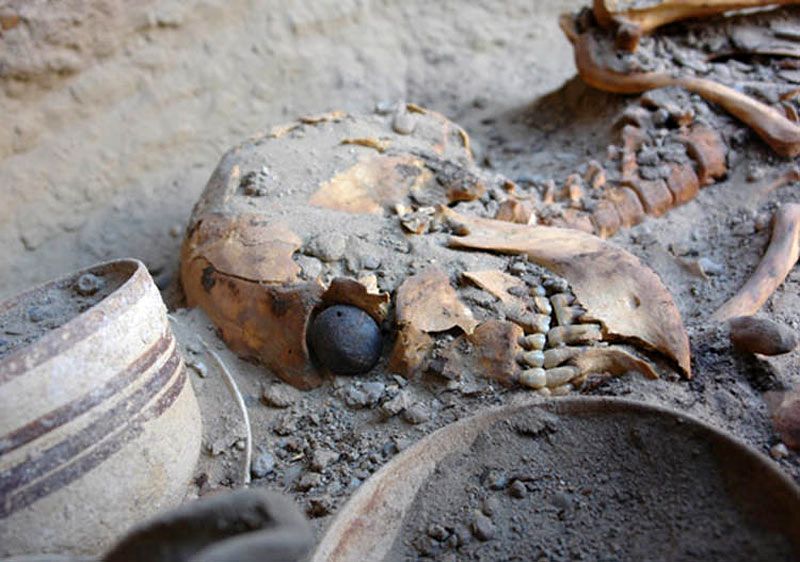
and began appearing upon handmade pottery. By the end of the Neolithic period, around 5000 to 5500 BCE, humans became settled. Agriculture and animal husbandry emerged, and pottery transformed into the visual language of daily life. Simple motifs minimal, and at times entirely abstract began to appear. Some even depict the movement of animals frame by frame; something remarkably close to the earliest form of animation in history. At Tepe Sialk in Kashan, precise geometric patterns can be seen as if the people of that era had created a language of their own through imagery. In Amlash and Marlik in northern Iran, pottery of a distinct artistic style has also been discovered evidence that cultures across the Iranian plateau had already formed identities unique to themselves. With the arrival of the Copper Age, around 5000 to 4000 BCE, pottery began shifting into shades of red and pale yellow, while black geometric patterns and hatched lines became widespread. This period marks the peak of artistic development before the formation of cities. And then, a major transformation occurred… The potter’s wheel was invented. In Sialk, Tepe Hissar in Damghan, Tall-e Bakun in fars, and Susa, pottery suddenly became symmetrical and precise a sign of professional workshops and the beginning of specialized production: a serious step toward civilization. At the same time, in eastern Iran in Jiroft, Shahdad, and Tepe Yahya carved stone vessels of extraordinary complexity were created. These objects were even exported to Mesopotamia, showing that the earliest networks of trade and cultural exchange had already formed across the Iranian plateau. And then we arrive at Shahr-e Sukhteh in Sistan around 3000 BCE. An advanced city with stepped houses, water piping systems, and bronze workshops. Here, humanity succeeded in creating one of history’s first alloys: bronze. A skull discovered with evidence of eye surgery reveals that medical knowledge also existed within this society. In Shahdad, a standard made of metal and stone was discovered a symbol of identity, power, and visual language among people who had not yet developed writing, but had already begun creating meaning. These are not merely ancient objects… Each one marks a step in humanity’s journey from hunter to city-builder.
Kohan Diyar… is the story of the land where our identity was formed.