Kohan Diyar is the story of our identity.Let us journey through history together for a few moments.
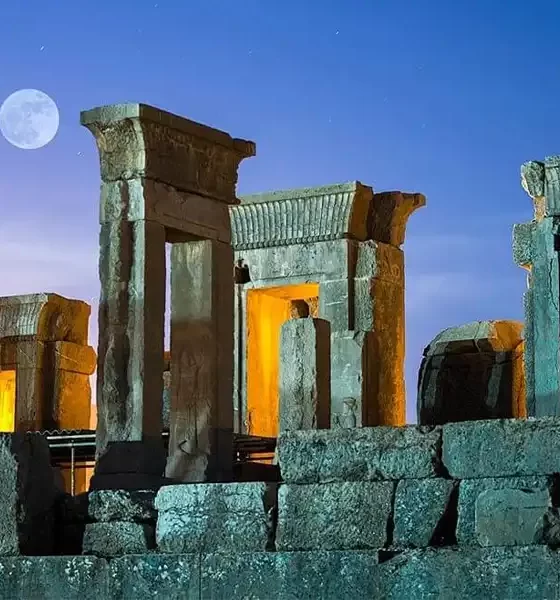
A story of a land that first portrayed the grandeur of its empire in the pale stones of Pasargadae where the visual identity of the Achaemenids began to take shape, and where power was inscribed in cuneiform. A path where the voice of the king was carved into stone and preserved for eternity in history.
The renowned figure of the Winged Man a relief carved upon one of the gateways of the Gate Palace depicts a human figure with four outstretched wings, dressed in a long, formal robe, wearing a crown composed of ram’s horns, a solar disk, and a cobra.
A symbol of divine glory or an idealized image of a sacred king. Alongside it, a trilingual inscription declares: “I am Cyrus, the Achaemenid king.” One of the most distinctive features of Pasargadae is the stronger presence of Egyptian and Mesopotamian influences within its reliefs. Following the conquest of Egypt by Cambyses, we find a surviving inscription of Darius the Great along the route of the canal connecting the Nile to the Red Sea. In this inscription, Darius introduces himself as: the Great King, King of Kings, King of Egypt, and King of Lands, and proclaims that this waterway was constructed by his command.
The significance of this inscription lies in how it demonstrates the language of authority and order of the Achaemenid king over distant territories of the empire. Here, Darius appears adorned in Persian royal attire and symbols, yet alongside the visual language of Egyptian art a rare and remarkable fusion of two great artistic traditions of the ancient world.
Kohan Diyar is the story of our identity…the story of a land that wrote its history not only in books, but upon the face of mountains.