Kohan Diyar is the story of our identity.Let us journey through history together for a few moments.
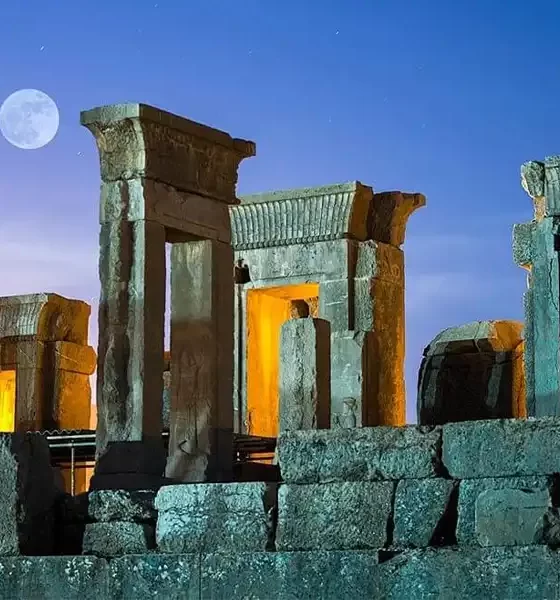
One of the most magnificent legacies of ancient Iran: Naqsh-e Rostam. Naqsh-e Rostam is an ancient necropolis located north of Marvdasht in Fars Province, approximately six kilometers north of Persepolis. It is considered one of the most important historical monuments of Iran. In ancient times, this site was known as Seh Gonbadan and Do Gonbadan, and only later did it become known as Naqsh-e Rostam.
The oldest surviving monument in this complex is a relief from the Elamite period. However, Naqsh-e Rostam is best known for its Achaemenid and Sasanian monuments. Here, four royal rock-cut tombs of the Achaemenid kings were carved directly into the mountainside, belonging to Darius the Great, Xerxes I, Artaxerxes I, and Darius II. These tombs, carved in the shape of monumental crosses into the cliff face, are among the most remarkable achievements of Achaemenid art celebrated for their form, grandeur, symmetry, and architectural innovation.
Among them, the Tomb of Darius the Great holds particular importance because of the inscriptions left by Darius himself. Its façade presents a symbolic image of the Achaemenid imperial worldview: Darius stands upon a platform, facing a sacred fire altar. Above him appears the symbol of the Faravahar, while his throne is carried by representatives of the many nations of the empire. This image reflects both the political majesty of the empire and the connection between earthly power and divine order. Also standing at Naqsh-e Rostam is the mysterious structure known as the Kaaba of Zoroaster
A square, tower-like stone monument located opposite the tomb of Darius II. This building was most likely constructed during the Achaemenid period. Its function, however, remains debated: Some scholars believe it was a tomb, others consider it a fire temple, a treasury, a repository for sacred texts such as the Avesta, or even a sanctuary dedicated to Anahita.
Naqsh-e Rostam also held immense significance during the Sasanian era. Ardashir I, founder of the Sasanian Empire, was the first king to create a relief here, depicting himself receiving the ring of kingship from Ahura Mazda. After him, other Sasanian kings carved scenes of coronation, battle, and military victory into the mountain.
The choice of Naqsh-e Rostam for these reliefs was not merely geographical It was a deliberate symbolic act. By placing their imagery beside the tombs of the Achaemenid kings, the Sasanians sought to connect themselves to the glory of ancient Iran and to legitimize their rule through cultural and political continuity.
Kohan Diyar is the story of our identity…the story of a land that wrote its history not only in books, but upon the face of mountains.