Costume in Seljuk and Safavid Miniatures

Costume, as one of the most prominent manifestations of material culture, occupies a significant position in Persian miniature painting, functioning not merely as a decorative element but as a carrier of complex social, ideological, and symbolic meanings. Miniatures from the Seljuk and Safavid periods—two pivotal eras in the history of Iranian art—reflect fundamental transformations in political power structures, social organization, religious beliefs, and aesthetic sensibilities, all of which are clearly manifested in the representation of dress.
This study adopts an analytical–comparative approach to examine costume in Seljuk and Safavid miniatures. By analyzing the formal, chromatic, textural, and structural characteristics of garments, the research identifies both the shared features and the fundamental differences between the two periods. Furthermore, changes in dress are interpreted within the cultural, political, and religious logic governing each era. The findings demonstrate that costume in Seljuk miniatures primarily reflects functional and traditional structures rather than individual identity, whereas in the Safavid period dress becomes a powerful visual instrument for expressing religious identity, social hierarchy, and political authority. This transformation signifies a shift from a functional perception of dress toward a symbolic and ideologically charged mode of representation in Persian miniature painting.
The study of costume in Iranian art, particularly in miniature painting, has a notable presence within the broader field of Islamic art studies. However, much of the existing scholarship has either addressed miniature painting in general terms or treated costume as a secondary, descriptive element. Works by scholars such as Yaghoub Ajand and Rouyin Pakbaz offer valuable insights into the visual characteristics of Persian miniatures, yet their analyses tend to focus on overall stylistic and aesthetic considerations rather than on dress as an independent cultural text. In the field of costume studies, authors such as Mohammad Torabi-Nia and Mahmoud Rouholamini examine clothing within the frameworks of anthropology and material culture. Nevertheless, these studies rarely establish a direct connection between historical dress and its visual representation in miniature painting. In English-language scholarship, prominent researchers including Eleanor Sims, Basil Gray, and Sheila S. Blair have extensively analyzed Persian miniature painting and occasionally addressed costume within their discussions. However, references to dress are often subordinate to stylisticor art historical concerns and seldom result in a systematic comparative analysis across historical periods. Consequently, a significant gap remains in the form of a comprehensive comparative study that examines costume as an independent system of meaning in Seljuk and Safavid miniatures. This research aims to address that gap through direct visual analysis of garments depicted in selected miniatures. This study is grounded in an interpretive–comparative analytical framework that integrates approaches from art history, material culture studies, and semiotics. Within this framework, costume is examined not merely as a functional object, but as a cultural sign imbued with meaning. The research employs a qualitative methodology, with data collected through visual analysis of selected miniatures from authenticated illustrated manuscripts of both periods. The criteria for selecting images include visual clarity, historical authenticity, and the presence of human figures with clearly identifiable garments. The analysis of costume in each miniature is based on the following criteria:
•Form and silhouette of garments
•Types of headgear
•Color and chromatic combinations
•Decorative elements and ornamentation
•The relationship between dress and the social role of the depicted figure In the final stage, findings are comparatively analyzed, and transformations in dress are interpreted in relation to the political, religious, and cultural contexts of each period.
Historical and Cultural Context of the Seljuk Period
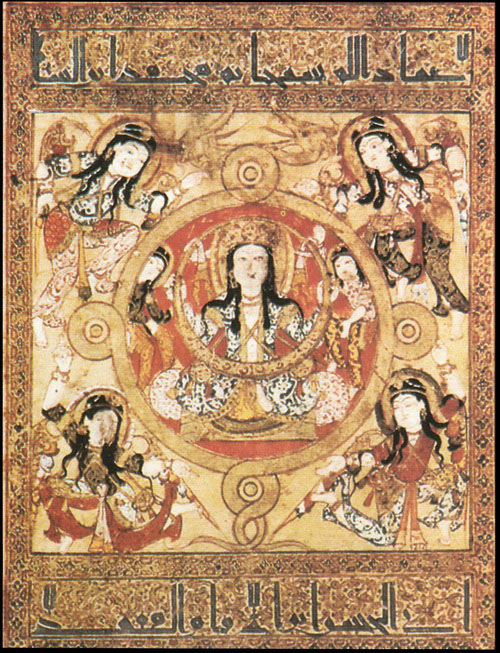
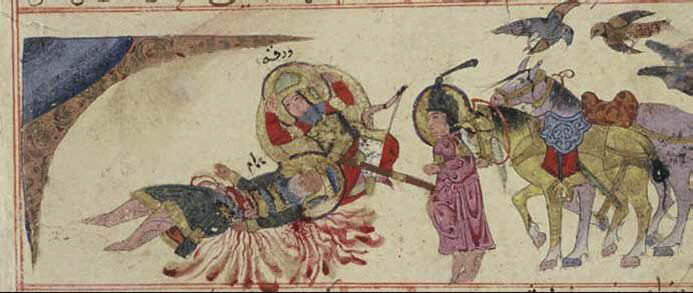
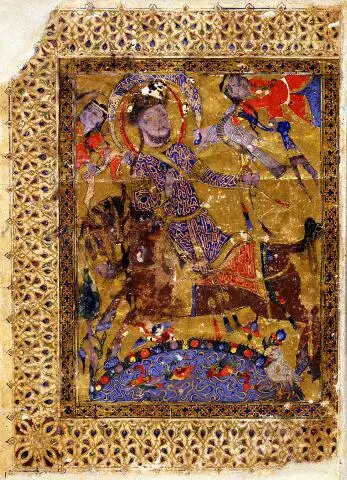
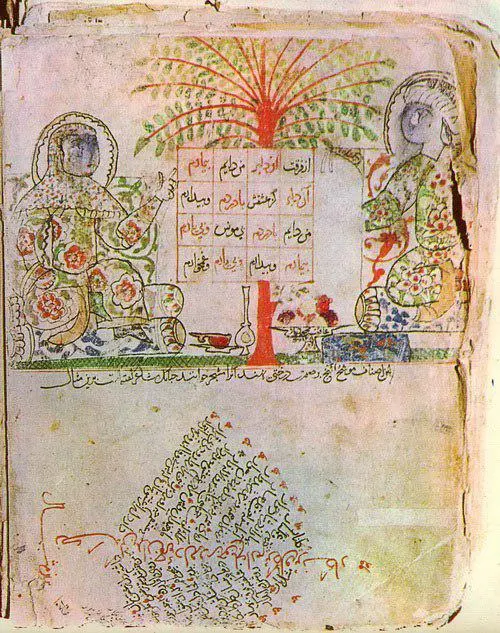
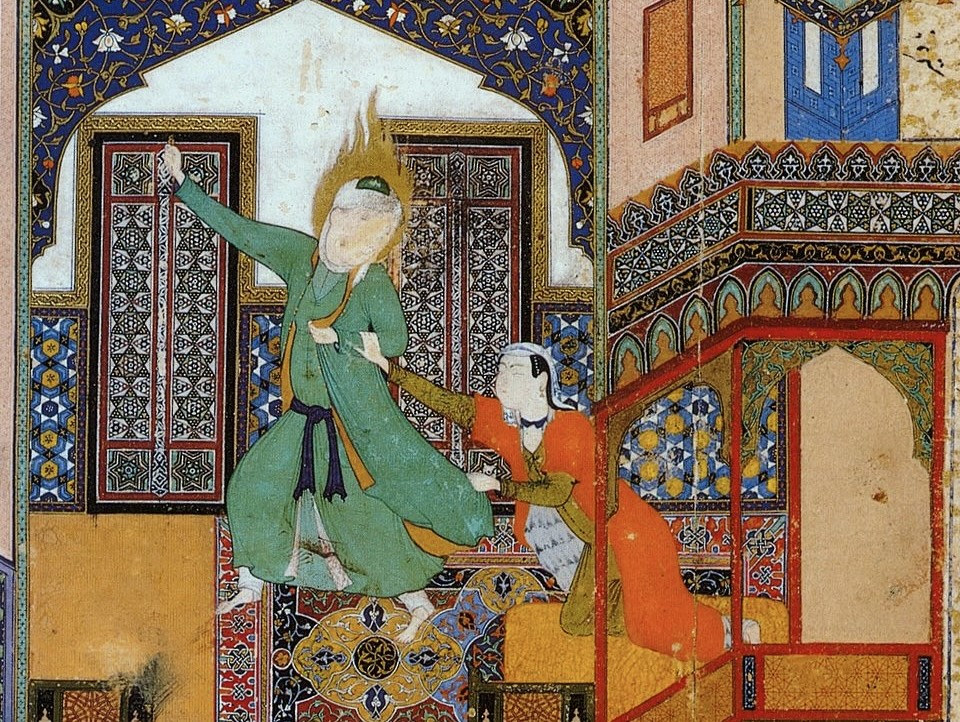
The Seljuk period (11th–12th centuries) witnessed the consolidation of Turkic political power in Iran alongside the continuation of Iranian–Islamic traditions. Culturally, this era represents a transitional phase in which Turkic, Iranian, and Islamic elements converged. During this period, miniature painting had not yet achieved the stylistic coherence and refinement characteristic of later centuries and remained closely tied to narrative functions and earlier visual traditions. Costumes depicted in Seljuk miniatures are generally simple, functional, and appropriate to courtly or military life, displaying minimal signs of excessive luxury or complex symbolism. The dress of this period reflects a society in which collective identity and social roles outweighed individual distinction an aspect evident in the relative uniformity and limited variation of garments.garments.
Analysis of Costume in Seljuk Miniatures
In Seljuk miniatures, figures are typically depicted wearing long, loose, multi-layered garments. The long robe with relatively wide sleeves is among the most common forms of dress, appearing in both courtly and narrative contexts. These garments generally lack complex tailoring and emphasize structural simplicity. Headgear often consists of conical or semi-rounded hats rooted in Turkic traditions, serving as indicators of social or military status. The color palette is limited, frequently dominated by earthy tones such as ochre, brown, and dark blue possibly reflecting technical constraints or prevailing aesthetic preferences. Decoration is minimal, usually confined to simple linear patterns or geometric motifs. This restraint suggests that costume in Seljuk miniatures primarily serves narrative clarity rather than symbolic expression. Overall, Seljuk costume imagery reflects a society in which tradition and function took precedence over the display of splendor or individual identity.
Historical and Cultural Context of the Safavid Period
The Safavid period (16th–17th centuries) represents one of the most ideologically cohesive eras in Iranian history. With the establishment of Twelver Shi‘ism as the state religion and the formation of a centralized government, art became a deliberate instrument for expressing political authority, religious identity, and royal magnificence. Safavid miniature painting particularly during the reigns of Shah Tahmasp and Shah Abbas reached a peak of formal, chromatic, and conceptual sophistication. In this context, costume functioned not merely as clothing but as an integral component of a visual language of power, encoding social rank, political allegiance, and spiritual authority. Unlike the Seljuk period, Safavid dress is highly codified; every garment, color, fabric, and ornament conveys specific information about the wearer’s position within the social and political hierarchy.
Analysis of Costume in Safavid Miniatures
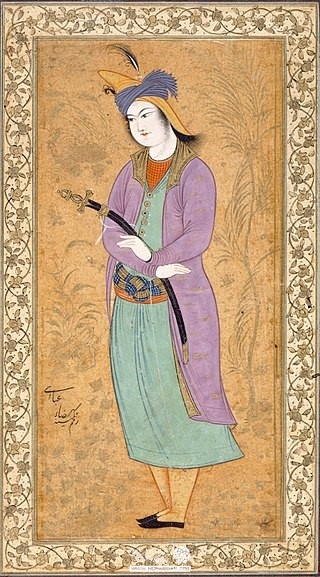
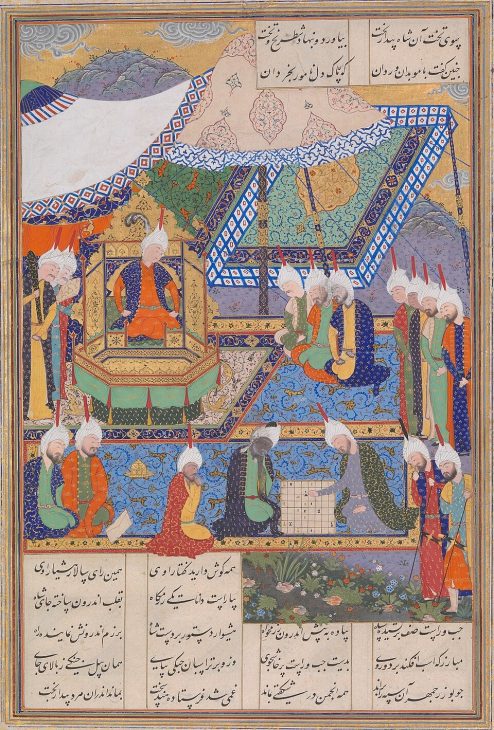
Safavid miniatures especially those found in manuscripts such as the Shahnameh of Shah Tahmasp—present richly diverse scenes of dress. Garments feature precise tailoring, complex layering, and elaborate decoration. The long Safavid robe is often cinched with a belt, creating a defined silhouette and visual order. Fabrics are richly textured and patterned, including silk, brocade, velvet, and imported textiles Fabrics are richly textured and patterned, including silk, brocade, velvet, and imported textiles evidence of economic prosperity and extensive trade networks. Colors are bold and symbolically charged: red, lapis blue, green, and gold are frequently employed, particularly in royal and courtly attire.
Headgear exhibits significant variety, most notably the Qizilbash hat with its distinctive twelve fold structure, which serves as a clear emblem of Safavid religious and political identity. Here, costume unmistakably functions as a tool for ideological representation. Decorative elements include vegetal and arabesque motifs rendered with exceptional precision, reinforcing the role of costume as a key contributor to the overall aesthetic unity of the image.
Comparative Analysis of Costume in Seljuk and Safavid Miniatures
A comparison between Seljuk and Safavid costume imagery reveals a fundamental shift in attitudes toward dress. In Seljuk miniatures, clothing is largely functional, restrained, and tradition-bound. Forms are loose, decoration is limited, and colors are subdued. Costume primarily signifies general social roles rather than individual or ideological identity.
In contrast, Safavid dress is visually rich, diverse, and conceptually layered. Garments clearly articulate social hierarchy, religious affiliation, and political power. Whereas differentiation among figures in Seljuk miniatures is achieved mainly through narrative positioning, in Safavid painting such distinctions are directly legible through dress. From a chromatic perspective, Seljuk miniatures favor limited, natural palettes, while Safavid artists employ color as a deliberate symbolic and compositional tool. Structurally, Seljuk garments are linear and static, whereas Safavid dress exhibits volume, depth, and movement aligning with the overall dynamism of Safavid compositions.
These differences indicate that changes in costume representation stem not merely from technical advancement, but from deeper transformations in societal conceptions of power, identity, and visual self-representation.
Analysis of the Historical Transformation of Costume
The evolution of costume from the Seljuk to the Safavid period cannot be attributed solely to artistic innovation or changing aesthetic preferences. Rather, it reflects a broader shift in intellectual frameworks, power relations, and perceptions of the human body within society.
During the Seljuk era, social and political structures were still stabilizing, and dress adhered closely to established traditions and functional norms. Garments concealed the body without emphasizing it; silhouettes were non-individualized, and distinctions of class or identity were understated. In contrast, the Safavid period witnessed a fundamental transformation in the role of imagery. Costume became a means of making social order visible. Tailoring grew more precise, the bodyCostume became a means of making social order visible. Tailoring grew more precise, the body gained visual significance, and dress framed and articulated physical presence signaling a new understanding of human identity within an ideologically structured state. Historically, this transformation coincided with expanded trade, access to luxurious textiles, and the growth of royal workshops. Consequently, dress transcended everyday necessity and became a medium for expressing authority, legitimacy, and identity.
Ideological, Social, and Aesthetic Readings of Costume
Costume in Seljuk and Safavid miniatures can be read as a visual text composed of multiplelayers of meaning. From an ideological perspective, Seljuk dress remains relatively neutral and implicit, whereas Safavid costume explicitly serves the visual articulation of Shi‘i ideology. The Qizilbash hat, symbolic colors, and lavish ornamentation exemplify this intentional visual strategy.
Socially, Safavid miniatures clearly depict hierarchical distinctions through dress, a feature far less pronounced in Seljuk imagery. This contrast underscores the Safavid emphasis on visualizing social order and class differentiation. Aesthetically, costume in Safavid painting functions as a dynamic component of composition, contributing movement, color variation, and visual rhythm. In Seljuk miniatures, by contrast, dress remains subordinate to the overall narrative structure and plays a limited role in directing the viewer’s gaze.
This shift marks a transition from a simple, narrative-oriented aesthetic to a complex, performative, and self-conscious visual language.
This study demonstrates that costume in Seljuk and Safavid miniatures functions as a profound reflection of historical, cultural, and ideological transformations rather than as a purely decorative element. In Seljuk imagery, dress is predominantly simple, functional, and minimally ornamented, serving narrative clarity more than symbolic expression. In Safavid miniature painting, however, costume attains the status of a visual language through which religious identity, political authority, and social order are articulated. This transformation reflects a fundamental shift in societal perceptions of the image, the body, and the role of art in representing reality. The comparative analysis reveals that changes in costume are not merely the result of technical or economic developments, but arise from deeper transformations in cultural logic and intellectual structures. In this sense, dress emerges as a visual document of historical thought and power relations. This research contributes to interdisciplinary scholarship in costume history, Islamic art, and cultural studies, demonstrating the rich potential of Persian miniature painting for analytical and interpretive inquiry.interpretive inquiry. Costume, Persian Miniature Painting, Seljuk Period, Safavid Period, Comparative Study, Cultural


keywords
Identity
References
Persian Sources:
•Ajand, Yaghoub. Negargari-ye Iran.
•Pakbaz, Rouyin. Encyclopedia of Art.
•Torabi-Nia, Mohammad. Costume in Islamic Iran.
•Rouholamini, Mahmoud. Culture and Symbol.
•Articles from Golestan-e Honar and Honar-haye Ziba Journals.
English Sources:
•Blair, Sheila S., & Bloom, Jonathan M. The Art and Architecture of Islam.
•Sims, Eleanor. Persian Painting.
•Gray, Basil. Persian Painting.
Encyclopaedia Iranica.
•Metropolitan Museum of Art Publications.